Separate duration and behaviour
301 and 308 indicate permanent moves; 302 and 307 indicate temporary moves. Method-preservation differences matter for requests beyond GET. An editorial document and a payment form are different cases. Test the actual service behaviour.
Keep redirects within their purpose
Temporary maintenance is not a permanent brand move. A deleted document without an equivalent does not always need a redirect. Avoid loops and chains that complicate diagnosis. Update links you control when the destination is permanent.
Inspect both response and destination
Check initial status, Location and final response. A successful final status with the wrong content does not validate the journey. Preserve genuinely necessary parameters and prevent arbitrary external destinations in public redirect mechanisms.
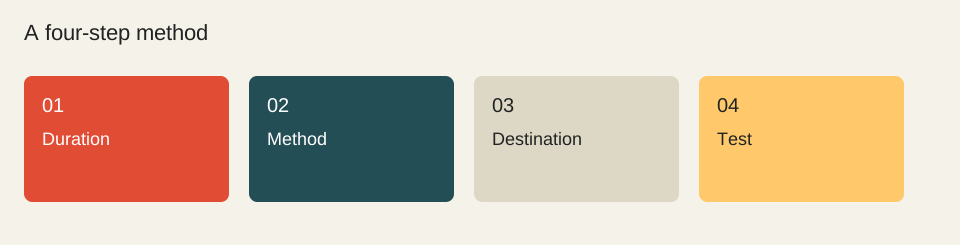
- Duration
- Method
- Destination
- Test
Worked example
An old article URL moves directly to its current equivalent with a permanent redirect. An unknown document remains an explicit absence. Form requests require tests suitable for their method and data handling.
Make it practical
HTTP response planner
Calculated on your device. Nothing is submitted to a server. Educational examples, without traffic or revenue promises.
Check before moving on
These checkboxes are not saved.
Sources & method
Sources reviewed on 1 October 2026. Worked calculations use explicitly hypothetical inputs.
Topic provenance: Du bon usage des redirections 302 (2007-09-13). Search Engine Feng Shui. Byline retained in the consulted version: François Houste.
This guide is newly written in 2026. It does not reproduce the earlier text and is not attributed to its historical author.