Collect the audience’s language
Start with support questions, problem descriptions and industry terminology, removing personal details. Distinguish definitions, supplier selection and troubleshooting. A short query such as “migration” can hide several unrelated tasks. Preserve the wording people use rather than replacing every phrase with internal jargon.
Group by the answer required
Combine phrases when one page can answer them well. Separate topics when readers need different documents: a comparison, a procedure or a product specification. Record territory and language rather than assuming that a literal translation has the same intent. Inspect dated real results before choosing a format.
Prioritise with evidence and capacity
Assess usefulness, your ability to produce supporting evidence and implementation cost. Keep the source and date of estimated volumes. Zero in a tool does not establish zero readers; a large estimate does not prove that you can meet their need. Inspect existing pages before creating a second page for the same task.
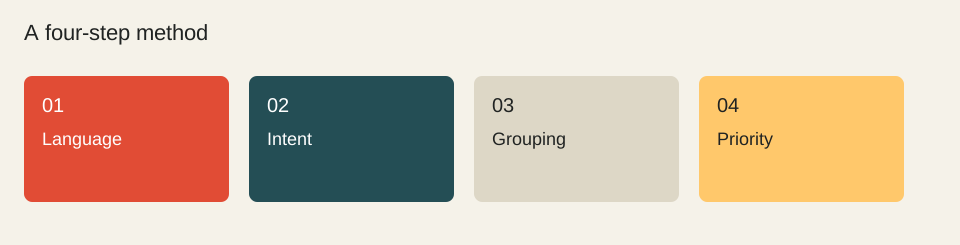
- Language
- Intent
- Grouping
- Priority
Worked example
“Canonical or redirect”, “redirect an old domain” and “temporary redirect during maintenance” are technically related but can justify different documents: a decision comparison, a migration procedure and an interruption plan.
Check before moving on
These checkboxes are not saved.
Sources & method
Sources reviewed on 1 October 2026. Worked calculations use explicitly hypothetical inputs.
Topic provenance: Trouver les bons mots-clés pour sa stratégie Search (2010-06). Search Engine Feng Shui. Byline retained in the publication feed: fhouste.
This guide is newly written in 2026. It does not reproduce the earlier text and is not attributed to its historical author.