Translate wording into a problem
The historical March 2009 post discussed an American Hitwise study of query length. Its percentages describe that earlier study, not searches in 2026. Record what each qualifier changes: location, budget, equipment, timing, compatibility or use case. “Packaging for glass” and “packaging for refrigerated glass shipments” may need different evidence; ten grammatical variants may need exactly the same answer.
Group queries that lead to the same decision
Create a table of wording, constraint, decision and existing page. Combine expressions when one worked example resolves the problem. Separate needs when procedures, compatible products or conditions genuinely differ. Do not create a page for each town without a local service or local information. Length is not usefulness: readers must locate their constraint quickly.
Check quality before scaling
Give each group a comparison, procedure or checkable limitation. Read the page with a specific scenario: what information is still missing for a decision? Then use available observations to inspect actual queries and outcomes. More visits alone do not establish better-qualified demand. Document enquiries and conversions using stable definitions.
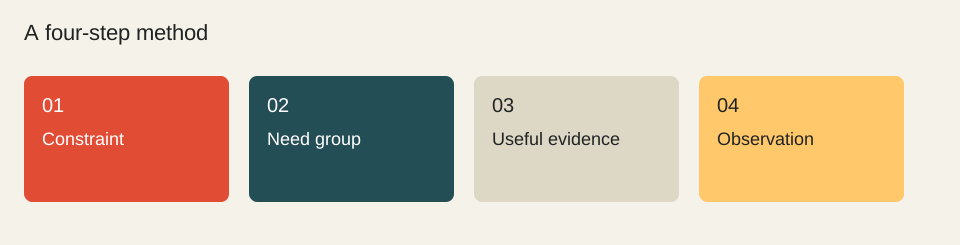
- Constraint
- Need group
- Useful evidence
- Observation
Worked example
“Move a WordPress blog”, “change WordPress domain” and “redirect the old WordPress domain” can fit one migration guide. “Preserve POST forms during a migration” requires a specific technical check. The separation comes from the task, not the number of words.
Check before moving on
These checkboxes are not saved.
Sources & method
Sources reviewed on 1 October 2026. Worked calculations use explicitly hypothetical inputs.
Topic provenance: Un tiers des requêtes contiennent plus de 3 mots-clés (2009-03). Search Engine Feng Shui. This record does not confirm an individual byline.
This guide is newly written in 2026. It does not reproduce the earlier text and is not attributed to its historical author.