Start with published inventory
List pages you want people to discover in search. Exclude drafts, internal searches and technical duplicates. Assign an owner and content type to each URL. This small inventory makes exceptions reviewable instead of burying them in a generated file.
Check every destination
Request the URLs with GET. Redirecting addresses are poor final destinations for this list. Compare the canonical and indexing directives too: perfectly valid XML can describe pages with conflicting instructions. Preserve the failed URLs for investigation.
Use a meaningful modification date
Record substantial content revisions rather than resetting every date daily. Updating a timestamp without changing the editorial substance does not establish freshness. Keep the file generation date separate from each page’s modification date.
Review additions and removals
After publication, check the file served in production, not just the local build. Save the URL count and exceptions. A sitemap helps discovery; its existence does not establish indexing or a particular search position.
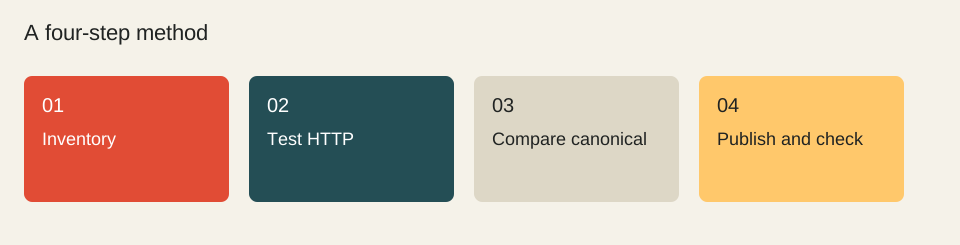
- Inventory
- Test HTTP
- Compare canonical
- Publish and check
Worked example
Worked example: a 120-address list contains four redirects and three noindex pages. Following CMS verification, the remaining 113 destinations become sitemap candidates. These figures demonstrate a procedure, not an observed result.
Check before moving on
These checkboxes are not saved.
Sources & method
Sources reviewed on 1 October 2026. Worked calculations use explicitly hypothetical inputs.
Topic provenance: Ask.com rejoint le protocole Sitemaps (2007-04-11). Search Engine Feng Shui. Byline retained in the consulted version: Thomas Poulard.
This guide is newly written in 2026. It does not reproduce the earlier text and is not attributed to its historical author.