Choose complete windows
Do not compare a finished month with the first few days of the next one. For weekday-sensitive activity, use complete weeks or equivalent weekdays. Document the reporting timezone and the timezone used for transaction records.
Keep the metric consistent
Users, sessions, orders and revenue describe different things. Write the definition before calculating a percentage. More sessions can coexist with fewer orders; showing only the first measure can conceal the commercial question that needs investigation.
Annotate relevant events
Record promotions, closures, migrations and measurement incidents. Simultaneous changes alone do not establish causation. When collection methods change, show a break in the series instead of suggesting that old and new observations are directly continuous.
Preserve absolute volumes
Percentages can disguise a small starting point. Show starting and ending values alongside the absolute difference. Use a longer window for small segments where appropriate, and explain collection limitations.
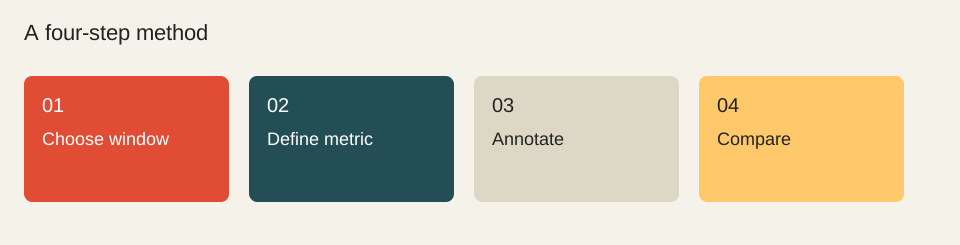
- Choose window
- Define metric
- Annotate
- Compare
Worked example
Illustrative example: moving from four to eight orders is +100%, but only four additional orders. Also show visits, opening days and measurement incidents so readers can interpret the movement.
Check before moving on
These checkboxes are not saved.
Sources & method
Sources reviewed on 1 October 2026. Worked calculations use explicitly hypothetical inputs.
Topic provenance: Enfin des statistiques par semaines ou mois sur Google Analytics (2008-04-04). Search Engine Feng Shui. Byline retained in the publication feed: François Houste.
This guide is newly written in 2026. It does not reproduce the earlier text and is not attributed to its historical author.