Describe both populations
State what triggers each observation: click, page load, session or order. A person may click and leave before site measurement starts. Multiple clicks can belong to one journey. Do not assume the reports should reconcile one for one.
Align reporting filters
Compare countries, devices, pages, dates and timezones. Check hostnames and included subdomains too. Canonical grouping in search data and raw URL grouping in site reports can move volumes between rows without changing the total population.
Test collection behaviour
Check an ordinary arrival, the consent choice and internal navigation. Blockers, JavaScript errors and lost parameters can affect measurement. Consent-based collection may not represent every visitor; preserve the person’s choice rather than bypassing it.
Connect diagnosis to an action
Use reports to find pages worth investigating, then inspect the actual journey. Keep definitions and incidents in a shared sheet. An unexplained gap is a diagnostic question, not immediate proof of fraud or disappearing traffic.
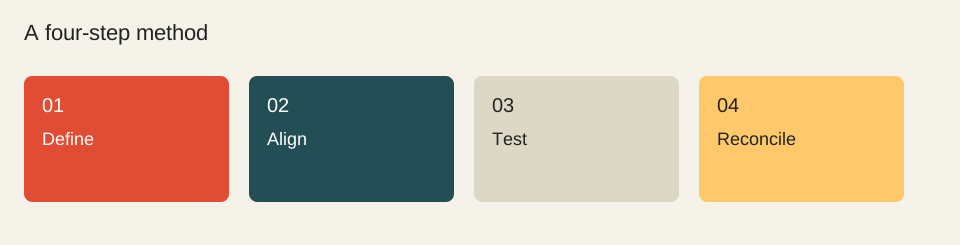
- Define
- Align
- Test
- Reconcile
Worked example
Reconciliation sheet: date / page / clicks / sessions / orders / consent / incident. Start with ten representative pages, expanding the checks if a common cause becomes apparent.
Check before moving on
These checkboxes are not saved.
Sources & method
Sources reviewed on 1 October 2026. Worked calculations use explicitly hypothetical inputs.
Topic provenance: Interpréter les données d’Analytics et de Webmaster Tools (2010-02). Search Engine Feng Shui. Byline retained in the publication feed: fhouste.
This guide is newly written in 2026. It does not reproduce the earlier text and is not attributed to its historical author.