Define the counting unit
Separate links, source pages and referring domains. One navigation link repeated across a thousand pages is not a thousand independent recommendations. Note whether a report includes lost links, HTTP and HTTPS variants, www hostnames and subdomains.
Align the reporting window
Record crawl dates, scope and filters. Different collection dates may describe different conditions. A newly discovered link may have existed for years; discovery time is not publication time. Keep these dates separate in your worksheet.
Inspect actual examples
Open source pages and check the visible link, surrounding context and destination. Classify editorial citations, directories, navigation and spam separately. A missing destination with a useful citation may matter more than a discrepancy between large totals.
Make a documented decision
Save examples that justify an action. Restore an appropriate missing page or request an obsolete link correction where useful. Third-party authority scores are not official Google metrics and do not guarantee rankings.
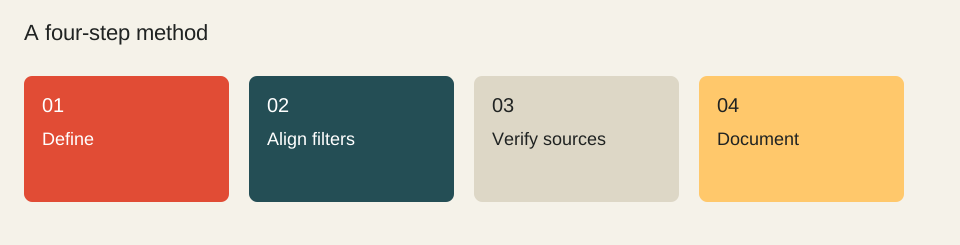
- Define
- Align filters
- Verify sources
- Document
Worked example
Example: tool A reports 900 links and B reports 600. If A includes 400 lost links while B reports active links only, the raw totals are not comparable. Apply a common scope before interpreting the gap.
Check before moving on
These checkboxes are not saved.
Sources & method
Sources reviewed on 1 October 2026. Worked calculations use explicitly hypothetical inputs.
Topic provenance: Yahoo! Site Explorer et les différences d’affichage des liens entrants (2007-10-15). Search Engine Feng Shui. Byline retained in the publication feed: Thomas Poulard.
This guide is newly written in 2026. It does not reproduce the earlier text and is not attributed to its historical author.