Establish provenance
List versions, dates and publication agreements. Verify rights before republishing third-party text. References should make factual origins understandable; a canonical annotation is not permission to reproduce a work. Keep licensing decisions separate from search configuration.
Assess editorial contribution
A useful republication may add analysis, verified data or a complete translation. Swapping a few words does not necessarily produce a distinct answer. If several pages on your own site answer precisely the same question, select a primary destination.
Use consistent signals
Within your site, align internal links, canonicals and sitemap entries with the editorial decision. Do not assume an annotation forces a search engine’s choice. For partner publications, agree the relevant instructions with their technical team.
Maintain corrections
A corrected source fact can remain inaccurate in republications. Keep a distribution list and a correction process. Explain substantive updates and preserve the original publication date rather than altering it simply to create an appearance of novelty.
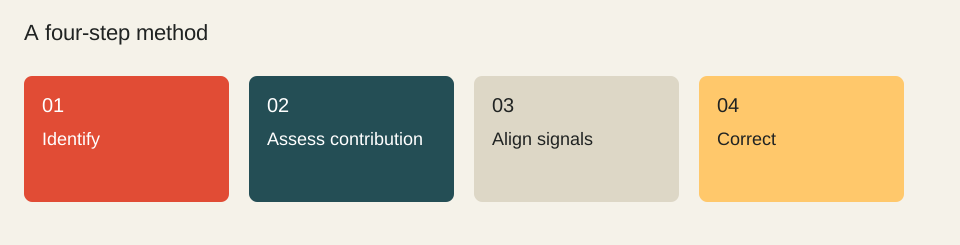
- Identify
- Assess contribution
- Align signals
- Correct
Worked example
Republication record: source / rights / original contribution / primary URL / correction contact. A press-release summary and an independent analysis can serve different roles; two complete copies need a different editorial decision.
Check before moving on
These checkboxes are not saved.
Sources & method
Sources reviewed on 1 October 2026. Worked calculations use explicitly hypothetical inputs.
Topic provenance: La chasse aux contenus dupliqués commence sur Google News (2007-09-03). Search Engine Feng Shui. Byline retained in the consulted version: François Houste.
This guide is newly written in 2026. It does not reproduce the earlier text and is not attributed to its historical author.