Explain the consideration
Record payment, supplied products or other benefits. Make the relationship understandable to readers and check applicable publication rules. A vague phrase is not enough to explain who funded an article or what influence was agreed.
Separate responsibilities
State who selects the subject, verifies facts and handles corrections. A partner may confirm product details without dictating a supposedly independent conclusion. Do not invent tests, testimonials or personal experience to strengthen the story.
Handle links appropriately
Paid links should be technically qualified under search-provider guidance. Check that destinations fit the article and do not collect data under a misleading presentation. Purchasing links is not a guarantee of search visibility.
Specify useful evidence
Request documents, methods, limitations and examples. Comparisons need stated criteria. Keep a revision process for prices and availability, then evaluate which reader questions the article actually resolves.
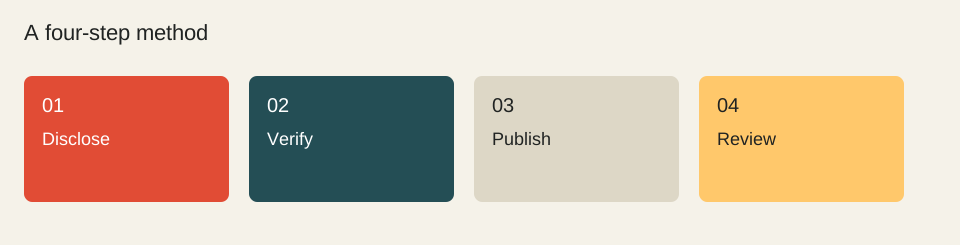
- Disclose
- Verify
- Publish
- Review
Worked example
Brief: commercial relationship / reader question / available evidence / unsupported claims to exclude / link treatment / review date. Connect each stated benefit to evidence or an explicitly labelled assumption.
Check before moving on
These checkboxes are not saved.
Sources & method
Sources reviewed on 1 October 2026. Worked calculations use explicitly hypothetical inputs.
Topic provenance: Du modèle de publicité au Pay Per Post (2007-04-23). Search Engine Feng Shui. Byline retained in the publication feed: François Houste.
This guide is newly written in 2026. It does not reproduce the earlier text and is not attributed to its historical author.