Build a question set
Separate navigation, information, comparison and action. Collect actual questions without unnecessary personal data. Record language, country and context; a result can help one intention while being unsuitable for another. Preserve how the examples were selected.
Define meaningful criteria
Specify accuracy, understandable sourcing, necessary freshness and ability to complete the task. Do not confuse visual preference with relevance. A short written rubric lets two reviewers discuss a concrete disagreement rather than comparing impressions.
Retain observations
Date captures and preserve weak examples alongside good ones. Results can vary, and one observation does not represent an entire engine. Separate advertising from non-advertising results in the analysis so different interfaces are not silently combined.
Explain limitations
State sample size, method and disagreements. For your own site, use findings to improve a missing answer or confusing journey. Do not turn a small assessment into a universal ranking of search engines.
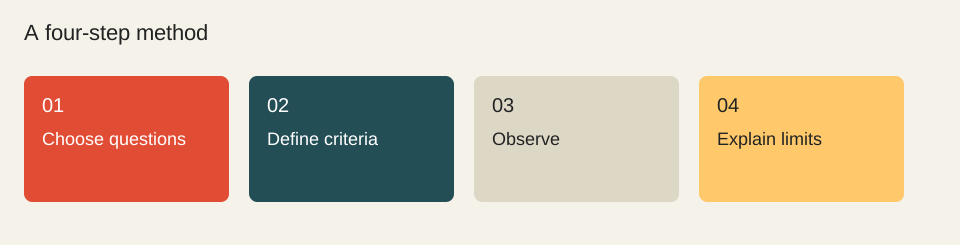
- Choose questions
- Define criteria
- Observe
- Explain limits
Worked example
Suggested rubric: question / intent / answer delivered / source / date / task completed / comment. Mark undetermined observations explicitly instead of assigning an arbitrary zero.
Check before moving on
These checkboxes are not saved.
Sources & method
Sources reviewed on 1 October 2026. Worked calculations use explicitly hypothetical inputs.
Topic provenance: Google est il encore un moteur pertinent ? (2008-04-08). Search Engine Feng Shui. Byline retained in the publication feed: François Houste.
This guide is newly written in 2026. It does not reproduce the earlier text and is not attributed to its historical author.