Define the comparison
Specify whether you are studying spelling, autocomplete, results or recommendations. These interfaces are not interchangeable. Record language, country, device and date; undocumented observations are difficult to reproduce or compare.
Prepare comparable pairs
Use formulations that differ only on the characteristic under investigation. Avoid contrived phrases designed to provoke a response. Preserve missing suggestions alongside displayed ones, and keep examples that contradict the initial hypothesis.
Limit interpretation
A visible difference does not establish a designer’s intention. Discuss plausible explanations and sample limitations. Separate observations, possible effects on users and proposed corrections rather than presenting all three as a demonstrated cause.
Publish responsibly
Remove unnecessary personal information from screenshots. Provide the protocol and verifiable examples. Where a finding concerns an identifiable person or organisation, include a correction route before turning an exploratory analysis into an accusation.
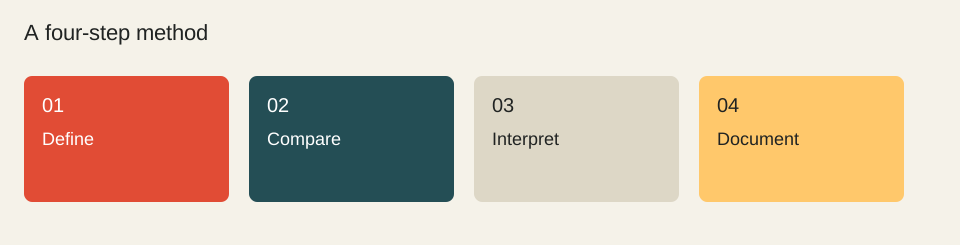
- Define
- Compare
- Interpret
- Document
Worked example
Study sheet: formulation pair / language / country / date / interface / observed response / uncertainty. Repeat over comparable dates before discussing whether a pattern is stable.
Check before moving on
These checkboxes are not saved.
Sources & method
Sources reviewed on 1 October 2026. Worked calculations use explicitly hypothetical inputs.
Topic provenance: Google serait-il sexiste ? (2007-05-15). Search Engine Feng Shui. Byline retained in the publication feed: François Houste.
This guide is newly written in 2026. It does not reproduce the earlier text and is not attributed to its historical author.