Define scope
List common requests, channels and realistic hours. Separate public information, account changes and commercial decisions. Agents should not promise refunds or timings they are not authorised to confirm. Write boundaries before discussing response speed.
Build a useful knowledge base
Provide approved answers, review dates and owners. Scripts should support understanding rather than prevent listening. Test cases with missing information and require explicit escalation instead of an invented answer that appears to close the enquiry.
Control access
Grant only what the work needs. Plan access withdrawal, confidentiality and conversation retention. Verify how personal-data requests reach the responsible person; a shared mailbox without a process is insufficient. Test permissions with representative cases.
Accept the escalation process
Try urgency, account errors and unusual requests. Verify transfer and ownership, then check that customers understand what happens next. Assess resolution and answer accuracy rather than speed alone, keeping unresolved cases visible.
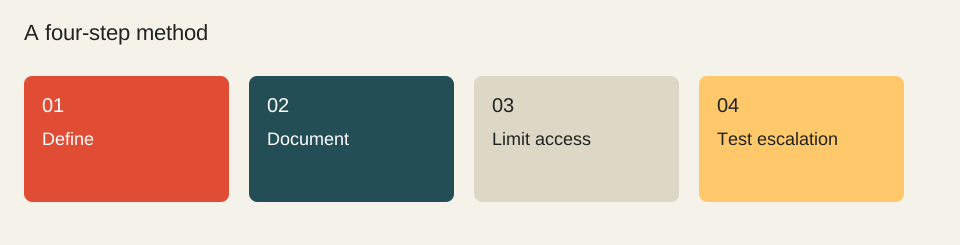
- Define
- Document
- Limit access
- Test escalation
Worked example
Case sheet: request / permitted answer / accessible data / boundary / escalation team / timing / customer message. An unforeseen case needs an identified destination rather than disappearing into an “other” category.
Check before moving on
These checkboxes are not saved.
Sources & method
Sources reviewed on 1 October 2026. Worked calculations use explicitly hypothetical inputs.
Topic provenance: Relation client : confiez-vous à plugandtel.com - search-engine-feng-shui.com (consulted capture: 2021-05-05). Search Engine Feng Shui. This record does not confirm an individual byline.
This guide is newly written in 2026. It does not reproduce the earlier text and is not attributed to its historical author.