Define the objects
Distinguish person, organisation, contact, opportunity and transaction. Assign suitable identifiers and matching rules. Some duplicates are legitimate; poorly specified automatic merging can erase useful distinctions or associate records with the wrong person.
Limit and document collection
Connect each field to a purpose and owner. Review information notices, permissions and retention. Do not add sensitive information merely because a platform includes corresponding fields in its catalogue. Record why a field is needed before importing it.
Check imports
Test encoding, dates, empty values and identifiers using fictional examples. Prepare an error report and rollback. An import that finishes without a message does not establish that every record has been associated correctly; compare expected and actual counts.
Organise maintenance
Assign corrections, authorised removals and definition changes. Maintain a data dictionary and verifiable exports. A specialist should hand over a process the team can operate rather than only an active connection that depends on undocumented choices.
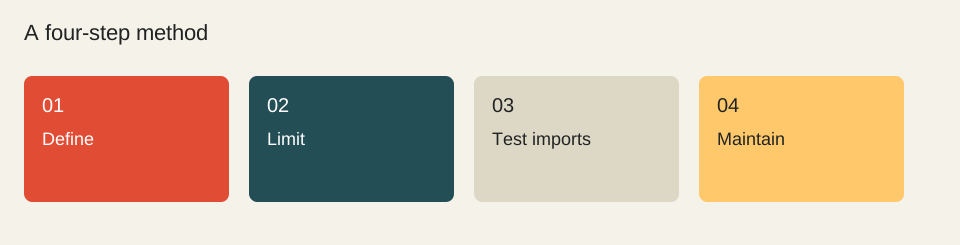
- Define
- Limit
- Test imports
- Maintain
Worked example
Dictionary: field / definition / fictional example / source / purpose / owner / validation rule. For dates, state format and timezone; for email, distinguish valid syntax from actual deliverability.
Check before moving on
These checkboxes are not saved.
Sources & method
Sources reviewed on 1 October 2026. Worked calculations use explicitly hypothetical inputs.
Topic provenance: Faire appel à un spécialiste de base de données - search-engine-feng-shui.com (consulted capture: 2020-08-05). Search Engine Feng Shui. This record does not confirm an individual byline.
This guide is newly written in 2026. It does not reproduce the earlier text and is not attributed to its historical author.