Define what counts
Choose an action and scope: validated purchase, qualified enquiry or confirmed booking. Apply an explicit cancellation rule. A form opening is not a sale. Keep the attribution period alongside the result.
Model before drawing conclusions
Expected contribution is visits × conversion rate × contribution per conversion. Subtract the total scenario cost. Calculator values are your assumptions, not a traffic forecast. Break-even conversion shows what would be required to cover the cost; it does not establish that the target is achievable.
Compare with observations
Compare assumptions with observations using consistent definitions. Distinguish revenue, contribution and acquisition cost. Identify excluded costs, consent effects, unobserved conversions and seasonality. More visits generating unsuitable enquiries can be economically negative.
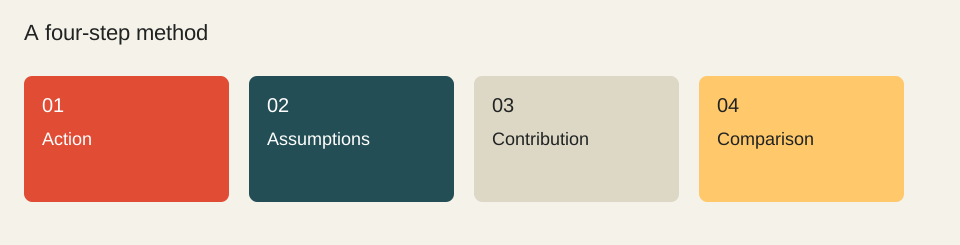
- Action
- Assumptions
- Contribution
- Comparison
Worked example
Fictional scenario: 1,000 visits, 2% conversion, €50 contribution per sale and €800 cost. Expected contribution is €1,000 and the balance €200. If contribution per sale is €20, the balance becomes −€400.
Make it practical
Campaign economics
Calculated on your device. Nothing is submitted to a server. Educational examples, without traffic or revenue promises.
Check before moving on
These checkboxes are not saved.
Sources & method
Sources reviewed on 1 October 2026. Worked calculations use explicitly hypothetical inputs.
Topic provenance: SEM : un pilotage en fonction du taux de retour ? (2009-09). Search Engine Feng Shui. Byline retained in the publication feed: fhouste.
This guide is newly written in 2026. It does not reproduce the earlier text and is not attributed to its historical author.