Define the voting purpose
A vote can represent interest, agreement or appreciation. Choose a meaning and explain it. Community rankings can help people discover resources without presenting every highly ranked item as accurate or editorially endorsed.
Manage conflicts of interest
Ask contributors to disclose connections with submitted content. Review coordinated campaigns and repeated submissions without assuming every active group acts maliciously. Rules should explain intervention grounds and provide a route to challenge a decision.
Retain human moderation
Use specific criteria: irrelevance, personal information, threats, undeclared promotion or unsupported assertions. Avoid unexplained removals. Moderation mistakes should be correctable and documented, with responsibility for handling appeals.
Measure discovery quality
Review author diversity, accessible sources and questions answered. A large vote total is not proof of reliability. Inspect a sample of prominent items and revise rules where recurring problems undermine the community’s stated purpose.
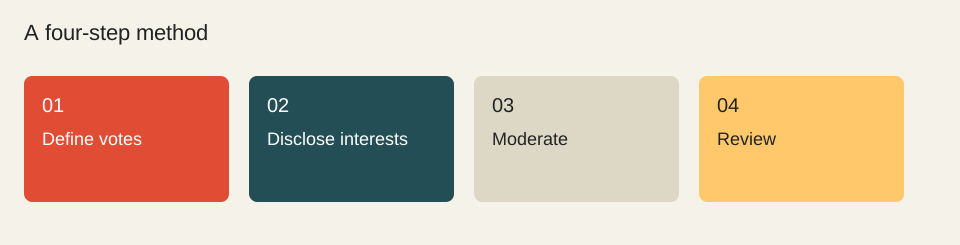
- Define votes
- Disclose interests
- Moderate
- Review
Worked example
Minimum charter: vote meaning / interest disclosure / moderation grounds / appeal route / correction responsibility. Try it against ten actual submissions before introducing complex additional rules.
Check before moving on
These checkboxes are not saved.
Sources & method
Sources reviewed on 1 October 2026. Worked calculations use explicitly hypothetical inputs.
Topic provenance: La chute de la maison Digg ? (2007-05-02). Search Engine Feng Shui. Byline retained in the publication feed: François Houste.
This guide is newly written in 2026. It does not reproduce the earlier text and is not attributed to its historical author.