Create a self-contained record
Identify title, creator where known, date or period, institution and reference number. Mark uncertainty instead of guessing an attribution. An original description should distinguish the object’s contents from interpretation. A stable link lets researchers cite the record.
Connect the file with context
Offer a transcription or readable description where possible. Identify file format and size before downloading. An unrecognised scanned text can be difficult to navigate. Images need appropriate alternatives, and long text inside an image also needs a textual equivalent.
Retain rights information
Preserve information and credits supplied by the holding institution. Online availability does not mean every republication is authorised. When rights are uncertain, a descriptive record and institutional link can help without reproducing the entire object.
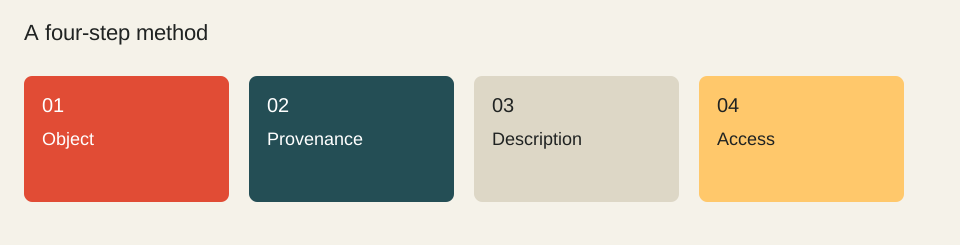
- Object
- Provenance
- Description
- Access
Worked example
A poster record can contain title, estimated period, collection, reference number, description and reuse status. A gallery of image001.jpg files does not provide these distinctions.
Check before moving on
These checkboxes are not saved.
Sources & method
Sources reviewed on 1 October 2026. Worked calculations use explicitly hypothetical inputs.
Topic provenance: Quelle visibilité pour le patrimoine sur les moteurs de recherche ? (2010-10). Search Engine Feng Shui. Byline retained in the publication feed: fhouste.
This guide is newly written in 2026. It does not reproduce the earlier text and is not attributed to its historical author.