Describe each journey
List steps before, during and afterwards for both audiences. Identify specific needs: venue access, stream access, timezones and support. Remote attendees should not depend on instructions announced only inside the room.
Organise participation
Assign someone to read remote questions and connect them with the discussion. Plan speaking and moderation rules. Polls and chat should serve an actual purpose rather than filling the interface with activity that does not help participants.
Prepare for failure
Test sound, captions, readable slides and a backup connection. Provide a support contact and an alternative if the stream fails. Decide beforehand whether a recording will be available, under which conditions and for how long.
Clarify data and rights
Inform attendees and speakers about recording and planned reuse. Avoid publishing private questions or contact information. Afterwards, release approved resources and make access limitations understandable rather than leaving people to infer them.
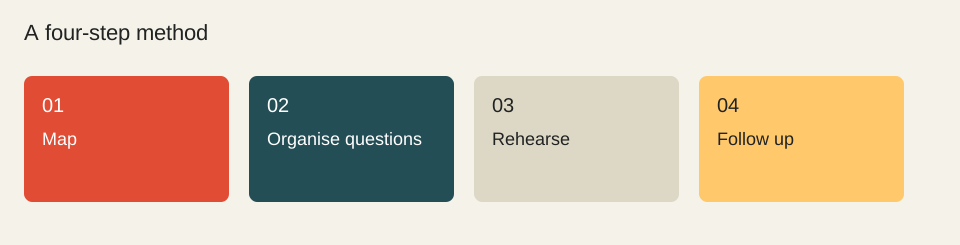
- Map
- Organise questions
- Rehearse
- Follow up
Worked example
Production sheet: moment / audience / message / owner / tool / fallback. Rehearse a five-minute stream loss and check that participants know where to receive the next update.
Check before moving on
These checkboxes are not saved.
Sources & method
Sources reviewed on 1 October 2026. Worked calculations use explicitly hypothetical inputs.
Topic provenance: Comment digitaliser un événement ? (consulted capture: 2023-06-03). Search Engine Feng Shui. This record does not confirm an individual byline.
This guide is newly written in 2026. It does not reproduce the earlier text and is not attributed to its historical author.