Record the measurement scope
Save the tool, territory, network, period and included variants with every observation. Keyword Planner average monthly searches depend on settings including period, location and close variants. A detached number is difficult to compare with another export.
Separate frequency and intent
Inspect a sample of results to understand the need. A term can combine definitions, purchases, troubleshooting and brand navigation. A commercial page does not automatically serve every intention. Group questions around the reader’s decision rather than creating one page for each similar phrase.
Keep uncertainty visible
Retain any range supplied by the tool instead of inventing precision from its midpoint. Do not sum variants that may represent the same search group. Relative Google Trends indices are not absolute search counts; store the two data types in different columns.
Turn research into editorial priorities
Compare the identified need, available evidence, actual offer and production effort. A less frequent question can solve an important problem. Record a priority hypothesis and compare it with available observations after publication. Estimated frequency proves neither future rankings nor how many clicks your page will receive.
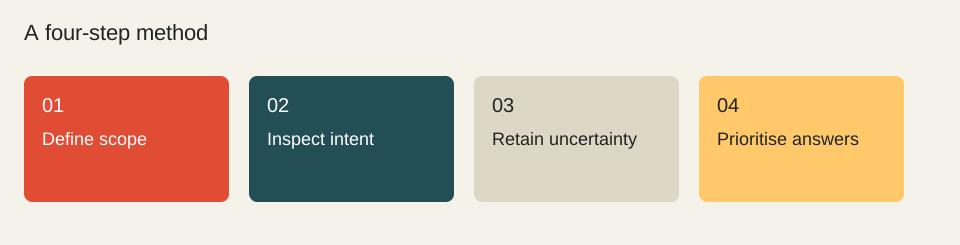
- Define scope
- Inspect intent
- Retain uncertainty
- Prioritise answers
Worked example
Fictional example: A reports 1,000 monthly searches and B reports 800, with overlapping close variants. This does not establish 1,800 independent searches. Preserve both estimates and their scope; retain one editorial question when the underlying need is the same.
Check before moving on
These checkboxes are not saved.
Sources & method
Sources reviewed on 1 October 2026. Worked calculations use explicitly hypothetical inputs.
Topic provenance: Google communiquera-t-il les volumes de requêtes ? (2007-03-09). Search Engine Feng Shui. Byline retained in the consulted version: François Houste.
This guide is newly written in 2026. It does not reproduce the earlier text and is not attributed to its historical author.