State the decision
Choosing an audience, testing an offer and setting a price are different questions. Define the possible consequence of each result. If every response leads to the same choice, research may merely confirm a pre-existing opinion.
Combine sources carefully
Distinguish public data, interviews and commercial observations. Record dates, scope and limitations. Competitors reveal visible offers, not necessarily profitability. A search trend is not a substitute for evidence that people will buy.
Interview without leading
Ask about past behaviour and difficulties. Avoid starting by praising your proposed solution. Document recruitment and refusals: people who accept an interview do not automatically represent the entire market. Preserve contradictory responses rather than editing them away.
Connect findings to choices
Present confirmations, contradictions and remaining unknowns. Recommend a proportionate next step: prototype, limited test or rejection of a hypothesis. Keep negative findings so the next team does not repeat the same unsuccessful experiment.
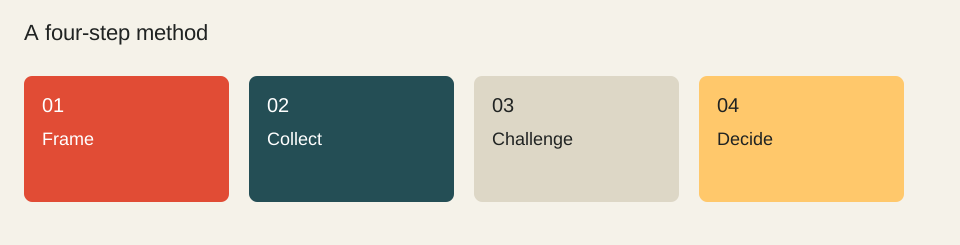
- Frame
- Collect
- Challenge
- Decide
Worked example
Interview outline: latest relevant situation / solution used / difficulty / cost or effort / alternative considered. Do not rely solely on “would you buy our product?”, which can exaggerate practical interest.
Check before moving on
These checkboxes are not saved.
Sources & method
Sources reviewed on 1 October 2026. Worked calculations use explicitly hypothetical inputs.
Topic provenance: Pourquoi réaliser une étude de marché marketing ? (consulted capture: 2021-09-18). Search Engine Feng Shui. This record does not confirm an individual byline.
This guide is newly written in 2026. It does not reproduce the earlier text and is not attributed to its historical author.