Define the actual operation
Distinguish premises that welcome customers from a business that visits them. Check eligibility and representation against current Google Business Profile guidance. Use the real-world business name rather than adding promotional keywords. A virtual office does not become a customer-facing location merely because it provides a postal address.
Align the information
Create a reference record covering public name, contact details, opening hours, services and service area. Assign someone to approve each field. Compare the Google profile with the location page and update both when details change. Do not turn a service area into several invented establishments.
Answer visit questions
Explain access, appointment requirements, known constraints and appropriate contact methods on the website. Describe accessibility facilities only when confirmed. A recent entrance photo can help if its caption identifies the location. Avoid advertising permanent availability where opening times depend on a particular service.
Check after changes
Test the destination link, published number and displayed hours. Record exceptions such as holidays and temporary closures. Ask someone unfamiliar with the place to review the page: can they identify the correct establishment and prepare a visit without contacting you for every detail?
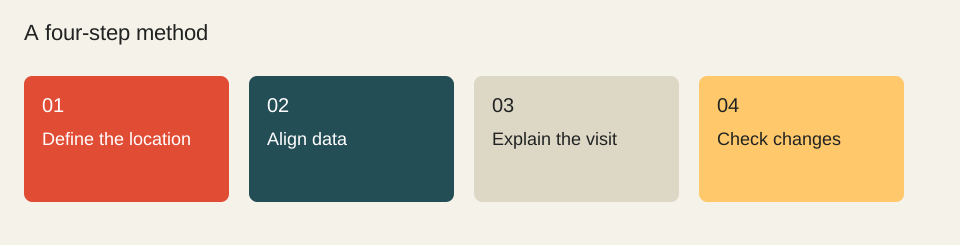
- Define the location
- Align data
- Explain the visit
- Check changes
Worked example
Fictional acceptance record: service — repairs; operation — visits to customers; public premises — none; service area — places actually served; appointment — required. The website explains the area and contact route without advertising a shop at a private home.
Check before moving on
These checkboxes are not saved.
Sources & method
Sources reviewed on 1 October 2026. Worked calculations use explicitly hypothetical inputs.
Topic provenance: Local Business Center, enfin l’avénement de la recherche locale ? (2007-08-09). Search Engine Feng Shui. Byline retained in the consulted version: François Houste.
This guide is newly written in 2026. It does not reproduce the earlier text and is not attributed to its historical author.