State a hypothesis
Write the need and minimum journey. A prototype can test interface comprehension without connecting to operational systems. Label fictional data and actions that do not yet produce real effects, keeping demonstration separate from delivery.
Observe actual use
Ask a representative person to complete a task without continuous coaching. Record hesitation, mistakes and missing information. Enthusiasm is not a substitute for observing a journey that someone finishes and understands.
Add production responsibilities
Before launch, assign access, backups, error handling and maintenance. Review licences and dependencies. No-code removes some programming steps, not the responsibility to protect information or recover from failures. Test the procedures rather than relying on a checklist alone.
Plan evolution
Keep documentation and exports. Decide what happens if the original creator leaves or a vendor changes terms. Define when a limitation warrants another solution instead of accumulating opaque automations around an increasingly fragile prototype.
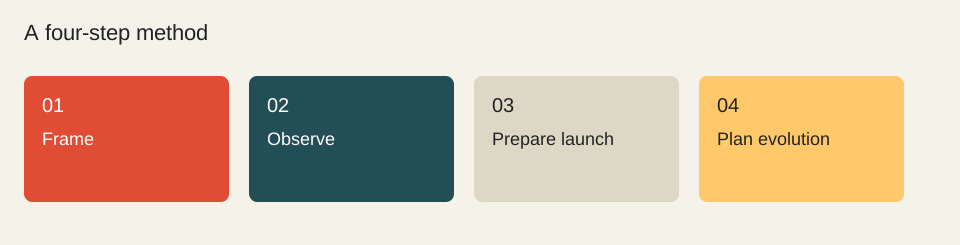
- Frame
- Observe
- Prepare launch
- Plan evolution
Worked example
Launch decision: confirmed need / tested journey / owner / backup / export / error handling. A pilot without a maintenance owner remains a pilot, even if its demonstration appears to work.
Check before moving on
These checkboxes are not saved.
Sources & method
Sources reviewed on 1 October 2026. Worked calculations use explicitly hypothetical inputs.
Topic provenance: Le no code : 3 choses à savoir (consulted capture: 2023-01-30). Search Engine Feng Shui. This record does not confirm an individual byline.
This guide is newly written in 2026. It does not reproduce the earlier text and is not attributed to its historical author.