Choose entry points
Offer topic, period or dossier groupings according to reader needs. A month page can help locate a publication, while a subject dossier answers a different question. Explain that distinction instead of multiplying almost identical lists.
Provide context for links
Give each entry a descriptive title and reliable time reference. Distinguish a bibliographic record, an old announcement and a new adaptation. A recruitment archive must not imply that the position remains available. Do not replace an old date merely to imitate a recent publication.
Maintain readable paths
Use keyboard-accessible links and pagination that retains context. A filter with no matches should provide a clear escape route. Test an exact phrase, an accent, a date and an unmatched query. Navigation should work without requiring readers to guess a historic URL.
Compare navigation and inventory
Reconcile the catalogue, HTTP responses and sitemap destinations. A relocated address needs a specific equivalent; an absence should remain explicit. XML supports discovery, while archive navigation helps people understand what they will find. A large link count cannot replace these acceptance checks.
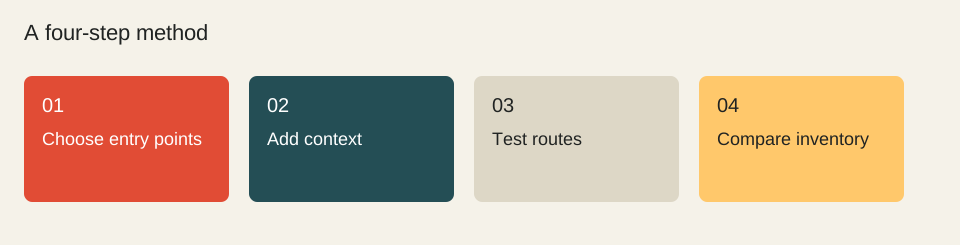
- Choose entry points
- Add context
- Test routes
- Compare inventory
Worked example
Fictional test: locate an April 2008 article by date and then by topic. Record the entry point, link path, final destination, HTTP status and content type. If both routes reach a record, that record should identify itself clearly before recommending modern guidance.
Check before moving on
These checkboxes are not saved.
Sources & method
Sources reviewed on 1 October 2026. Worked calculations use explicitly hypothetical inputs.
Topic provenance: Le New-York Times est-il éthique ? (2007-11-14). Search Engine Feng Shui. Byline retained in the consulted version: François Houste.
This guide is newly written in 2026. It does not reproduce the earlier text and is not attributed to its historical author.