Define needs before testing
Choose a factual lookup, a comparison, a local request and an ambiguous term. For each task, write what a useful answer must help someone decide. Include a question with no verifiable answer available: a responsible collection should acknowledge that limit. Retain the criteria before opening results rather than adapting them to whichever destinations are available.
Inspect answers, not just headlines
Open each destination and record what it actually addresses. A popular article may omit the required situation, and a human selection can repeat a dominant viewpoint. Separate relevance, accuracy, timeliness and task completion. A single overall score can hide the reason an answer fails.
Make judgement reproducible
Save the query, date, context, URLs and reasons for the verdict. If two people assess answers, let them work independently before comparing observations. A disagreement may expose an unclear instruction. The worksheet describes editorial evaluation, not an official ranking system or proof of general superiority.
Repair and repeat the task
When an interpretation is missing, add an explanation or appropriate destination with its source. Avoid increasing links merely to appear comprehensive. Assign an owner and review date. Repeat the original requests after changing the page: readers should be able to find the missing answer rather than simply encounter a longer collection.
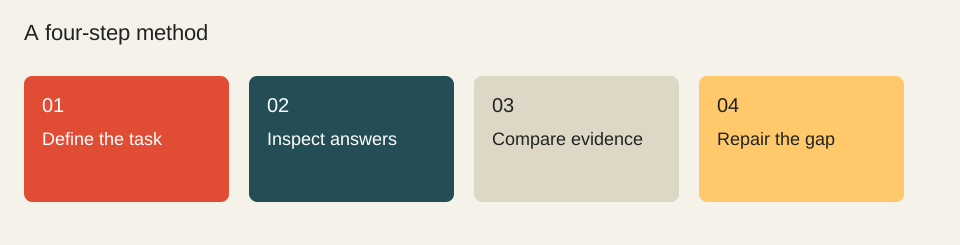
- Define the task
- Inspect answers
- Compare evidence
- Repair the gap
Worked example
Fictional case: “jaguar” can mean an animal or a car. An excellent automotive collection fails “identify the animal’s habitat”. Record intention: zoology; expected evidence: sourced habitat description; verdict: off topic. Add an explicitly labelled animal interpretation. Success on this example does not establish superiority across all searches.
Check before moving on
These checkboxes are not saved.
Sources & method
Sources reviewed on 1 October 2026. Worked calculations use explicitly hypothetical inputs.
Topic provenance: MAHALO : un moteur de recherche humain ? (2007-06-12). Search Engine Feng Shui. Byline retained in the consulted version: Thomas Poulard.
This guide is newly written in 2026. It does not reproduce the earlier text and is not attributed to its historical author.