Provide context
Explain audience, purpose, terminology and references. Flag product names, units and passages requiring legal or technical review. Isolated interface strings are hard to translate accurately without seeing the job they perform within the user journey.
Adapt without inventing
Local examples may change where facts remain verifiable. Do not create a fictional address to make a page appear local. Preserve offer limitations and actual responsibilities in every language instead of making the translated version more persuasive than accurate.
Publish complete equivalents
Each version should answer the same need with its main content, assistance and practical information. A partly translated page is not necessarily equivalent to a full guide. Language annotations should describe the versions actually available to readers.
Test the journey
Check titles, buttons, links, forms and errors. Some languages expand labels; measure narrow-screen geometry. Plan synchronised corrections so equivalent versions do not drift silently after the initial translation is accepted.
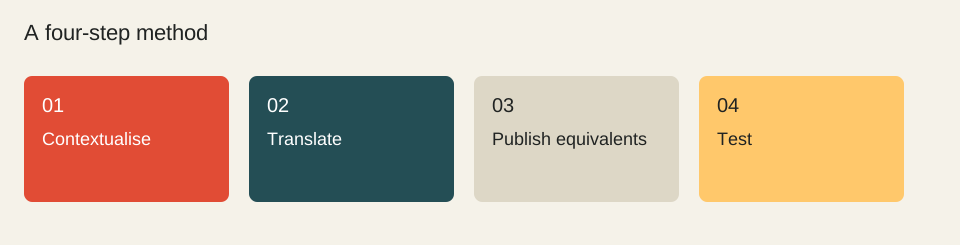
- Contextualise
- Translate
- Publish equivalents
- Test
Worked example
Handover sheet: source URL / local URL / complete content / approved terms / links / mobile acceptance / review date. A technical correction to the source creates an explicit task for each equivalent version.
Check before moving on
These checkboxes are not saved.
Sources & method
Sources reviewed on 1 October 2026. Worked calculations use explicitly hypothetical inputs.
Topic provenance: Fournir des contenus de qualité grâce à une entreprise de traduction à Paris - search-engine-feng-shui.com (consulted capture: 2021-01-23). Search Engine Feng Shui. This record does not confirm an individual byline.
This guide is newly written in 2026. It does not reproduce the earlier text and is not attributed to its historical author.
Translate the measurement, not just the sentence
A translation can be fluent and still change the instruction. This practical exercise uses an exact metric conversion and an ambiguous unit to show when to translate, when to convert and when to ask the source author.
- Mark every number, unit and decimal separator before translating. Keep an untouched copy of the source sentence and its context.
- Convert only when the unit is unambiguous and the audience needs the conversion. Keep enough precision for the task; do not invent greater accuracy than the source.
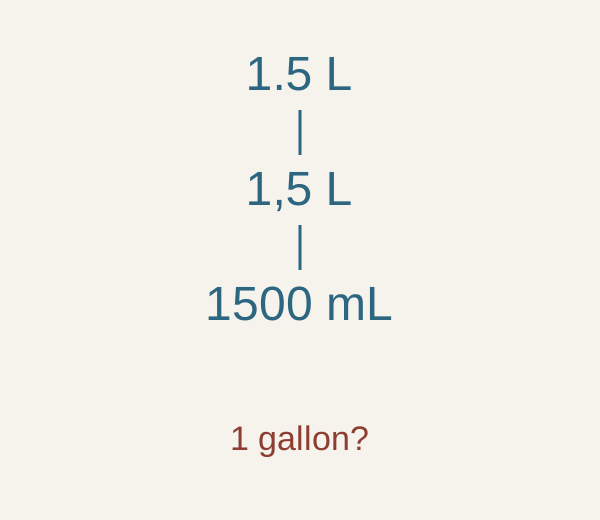
- Treat a bare “gallon” as a question, because US and imperial gallons differ. Do not choose a system silently.
- Read the completed instruction as a user would perform it. Check the number, unit, container and sequence together, then record who resolved any ambiguity.
| Field | Example or check |
|---|---|
| Source instruction — invented | “Add 1.5 L of water to the container.” Scope: an editing exercise, not a recipe or chemical procedure. |
| French equivalent | “Versez 1,5 L d’eau dans le récipient.” The decimal separator changes; the amount remains 1.5 L. |
| Exact alternative | 1500 mL = 1.5 L. Write “1 500 mL” in a French layout if that makes the measuring vessel easier to use. |
| Unresolved source | “Add 1 gallon.” Ask which gallon and which source specification applies before publishing a conversion. |
| Review record | Source __; quantity/unit __; target wording __; exact or rounded conversion __; unresolved point __; reviewer __. |
Changing a decimal mark is localisation; changing the quantity is a factual edit. Keep both visible in the review record.
Sources: BIPM — SI Brochure